
Drive Line Services in Marietta, GA: Driveshafts, U-Joints, CV Axles and Transfer Cases
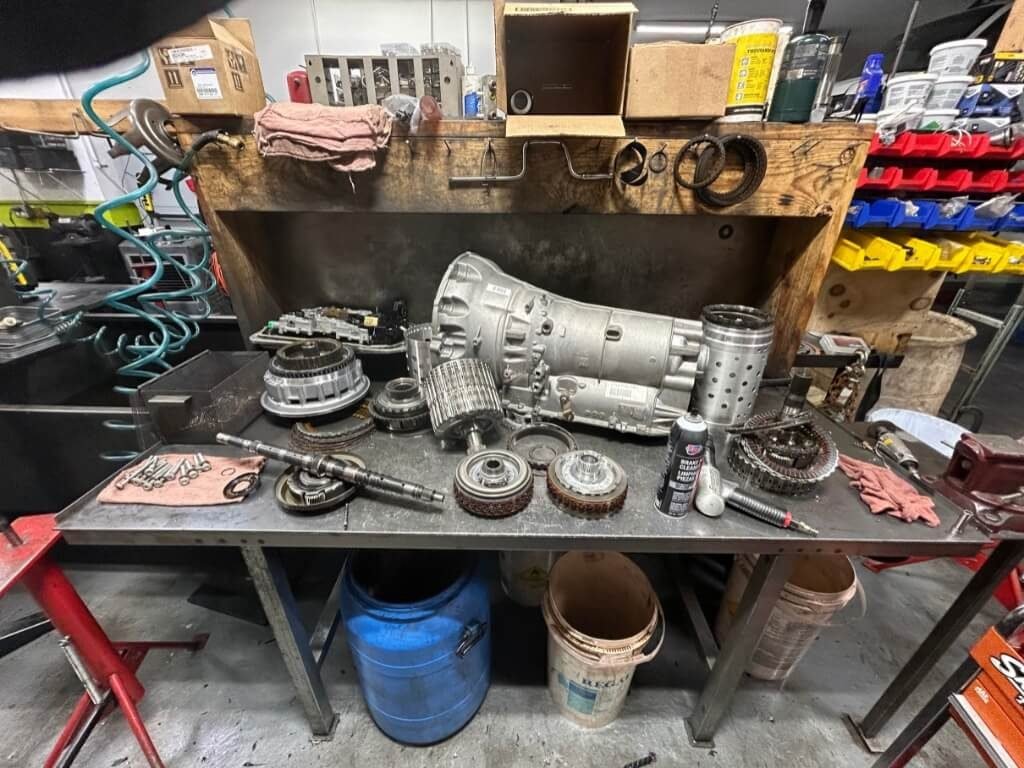
Short answer: If your vehicle clunks when you shift into gear, shakes at highway speed, or clicks when you turn, the cause is often in the drive line. That is the set of parts that carries power from the transmission to the wheels: the driveshaft, U-joints, CV joints, axles, differential and, on four-wheel drive vehicles, the transfer case. These parts wear out on their own schedule, and when one lets go it can strand the vehicle or damage the transmission next to it. Guardian Transmission Repair in Marietta, GA is a transmission shop, and drive line problems often show up as transmission complaints before anyone knows the real source.
What counts as the drive line?
The drive line is every rotating part between the transmission output and the wheel hubs. Which parts your vehicle has depends on how it is laid out.
The differential holds the ring and pinion, carrier and bearings, and it runs on gear oil. The transfer case on a four-wheel drive splits power between the axles using a chain or gears. Both can whine, leak or bind when they wear.
Work trucks, delivery vans and tow vehicles put more load on these parts than a commuter sedan does. A family SUV that sits in Cobb County traffic and then makes a highway run wears them differently. Either way, the parts are the same and so are the warning signs.
What are the symptoms of a bad driveshaft or U-joint?
A worn U-joint or driveshaft usually announces itself with a vibration that rises with road speed, a clunk when the vehicle goes into gear, or a squeak at low speed. Symptoms often start small and get louder over weeks.
- Vibration through the floor or seat that gets worse as speed climbs
- A single clunk when you shift from park to drive or from drive to reverse
- A rhythmic chirp or squeak at low speed that matches wheel rotation, often from a dry U-joint
- Shudder under hard acceleration
- A rumble or hum from underneath that changes with speed but not with engine rpm
- Visible rust-colored dust around a U-joint cap, which can mean the joint has been running dry
On longer driveshafts, a failing center support bearing adds a growl or a vibration that shows up in a narrow speed range. An out-of-balance shaft, from a lost weight or a dent, can feel just like a bad joint. Those are different repairs, so the cause has to be confirmed before parts get ordered.
Our article on the warning signs that a transmission is going out is a useful companion here, since several of these symptoms overlap.
How long can you drive with a bad driveshaft?
There is no safe mileage. A worn U-joint can run for weeks with a clunk, or it can seize and break in a day. Treat any driveshaft vibration or clunk as a reason to stop driving soon and have it looked at.
Here is why waiting is a bad bet. A U-joint that fails completely can let the driveshaft drop or whip around under the vehicle. That can bend the shaft, damage the transmission tail housing and seal, and hit brake lines, fuel lines or the exhaust. On a rear-wheel drive truck at highway speed, it can also take away control for a moment. The repair that costs a joint kit today can turn into a shaft, a seal and a tow later.
If you run a fleet, a vehicle with a vibrating driveshaft should come off the route until it is inspected. The downtime from a roadside failure costs more than a scheduled shop visit.
Can you drive with a clicking CV joint?
You can drive a short distance on a clicking CV joint, but it will keep getting worse and it can fail without much warning. Get it inspected soon. The click means the joint has worn past the point where fresh grease alone fixes it.
CV joints sit at both ends of a front-wheel drive half-shaft. The outer joint clicks or pops when you turn sharply, such as in a parking lot. The inner joint tends to cause a shudder or vibration when you accelerate. Both are protected by a rubber boot filled with grease.
The boot is the early warning. A split boot flings grease onto the inside of the wheel and the suspension parts, and dirt gets in. If the boot is caught while the joint is still quiet, the repair may be limited to the boot and fresh grease. Once the joint clicks, the usual fix is a new joint or a replacement axle shaft. If a joint breaks apart, the vehicle loses drive to that wheel and you are waiting on a tow.
Why does my car hesitate when I shift from park to drive?
A delay or hard clunk after shifting out of park can come from low or degraded fluid, lost internal pressure, a worn mount, or slack in the drive line. The cause can sit in the transmission or just behind it, so it needs inspection and testing to confirm.
The possibilities break into two groups:
- Delay before the vehicle moves. Low fluid, a worn pump, worn seals, weak clutch packs, a sticking valve body or solenoid, or a clogged filter can all let line pressure drop. The transmission takes a second or two to build enough pressure to engage. Our guide to symptoms of low transmission fluid explains how to check your level and read the color and smell.
- Engagement with a thump. Worn engine or transmission mounts, loose U-joints or worn differential gears add slack to the system. The slack gets taken up with a bang when torque first hits.
A vehicle that delays and then slams into gear can have both problems at once. Do not guess. Transmission fluid service is a reasonable first step if the fluid is low or old, but if the delay continues after that, internal wear is likely.
Can I drive with the check engine light on if it is a transmission code?
A steady check engine light with a transmission code allows a short, gentle drive to get scanned. A flashing light, limp mode, slipping, or harsh shifting can point to a serious problem, so stop driving and have the vehicle diagnosed. Continued driving can turn a solenoid or sensor fault into internal damage.
The transmission control module, or TCM, watches speed sensors, fluid temperature and shift solenoid response. When something falls outside expected ranges, it stores an OBD-II trouble code. Some codes point at a cheap fix such as a wheel speed sensor or a wiring fault. Others point at slipping, a torque converter clutch problem or overheating.
Many vehicles go into limp mode when the TCM sees a serious fault. The transmission stays in one gear to protect itself. That keeps you rolling slowly, but it is a signal to get the vehicle to a shop, not a fix. A code tells you where to look. It does not name the failed part.
What does drive line diagnosis involve?
Diagnosis depends on the symptom, and the steps below show what a thorough inspection can include. The goal is to find out which part is worn before anything is replaced.
- A road test to reproduce the noise, vibration or clunk and note speed, load and turning conditions
- A lift inspection to look at boots, seals, mounts, joint caps and fluid leaks
- Checking U-joints, center bearings and CV joints for play by hand
- Checking driveshaft runout and balance when vibration is the complaint
- A computer scan for stored OBD-II codes and TCM data
- A fluid check on the transmission, and on the differential and transfer case when the vehicle has them
Some drive line noises come from the transmission itself, and some transmission symptoms come from the drive line. That is the reason a shop that works on both is useful. A vibration blamed on a transmission rebuild may turn out to be a $0 balance weight problem, or the reverse. Sorting that out first saves money.
What affects the cost and timeline of drive line work?
Cost depends on which part failed, how many parts failed, and your vehicle. No honest quote is possible before diagnosis. Timeline depends mostly on parts availability and how much else is damaged.
The main factors:
- Make, model and year, since some vehicles use a common joint kit and others need a specific shaft
- Layout: front-wheel, rear-wheel, all-wheel or four-wheel drive
- Whether a joint can be replaced alone or the whole shaft or axle has to be replaced
- Whether a failure has already damaged a seal, a bearing or the transmission tail housing
- Parts availability for imported and domestic makes
- Labor hours, which vary with how much has to come apart for access
Ask whether a diagnostic fee is credited toward the repair, and ask for the warranty terms in writing before you approve work. If you are comparing shops, our guide on how to choose a transmission shop in Marietta lists the questions worth asking us as well.
Why bring a drive line problem to a transmission shop?
Drive line and transmission problems share symptoms, so one shop looking at both can find the real cause faster. Guardian Transmission Repair is a transmission shop in Marietta, GA, and its work centers on what happens between the engine and the wheels.
We serve residential drivers and commercial vehicles in Marietta, East Cobb, Kennesaw, Acworth, Woodstock, Roswell, Sandy Springs and Sandy Plains. The practical benefit is simple: if a clunk turns out to be a transmission problem, you do not start over at a second shop. If the transmission is fine and the drive line is the issue, you find that out before paying for the wrong repair.
Related transmission services
Drive line trouble often sits next to a transmission issue, and the repair path depends on what testing finds.
- If the problem traces back to shifting, slipping or delayed engagement, see automatic transmission repair in Marietta and East Cobb.
- If your vehicle has a continuously variable transmission and shudders or whines, see CVT transmission repair.
- If the vehicle has a stick shift and the issue involves the clutch or linkage, see manual transmission repair.
- If internal damage is serious enough that the transmission needs to come out and be rebuilt, see custom transmission rebuilds in Marietta.
- For the full list of what we cover from the engine back to the wheels, see our services overview.
Mistakes at home can make drive line and transmission damage worse. Our list of seven mistakes that kill transmissions covers the common ones.
Drive line service FAQs
Is a vibration at highway speed always a driveshaft problem?
No. Out-of-balance tires, bent wheels, worn suspension parts and engine issues can feel the same. A driveshaft vibration usually follows road speed and often shows up under load. A road test and an inspection separate the causes.
Can a bad U-joint damage my transmission?
Yes. A joint that fails can let the driveshaft move and damage the tail housing and output seal. The seal then leaks fluid, which creates a second problem. Early repair keeps the job small.
How do I know if a leak is from the drive line or the transmission?
Location and fluid type help. Transmission fluid is usually red or brown and sits toward the middle of the vehicle. Gear oil from a differential smells strong and is thicker. Grease flung around a wheel usually points to a torn CV boot. A lift inspection confirms the source.
Should I replace one CV axle or both?
Replace the one that is failing. The other side wears at its own pace. If both boots are torn or both joints are noisy, doing both at once can save a second visit.
Do all-wheel drive and four-wheel drive vehicles need extra drive line service?
They have more parts to wear: a transfer case, extra shafts and a second differential. Each has its own fluid, and low or old fluid shortens their life. Binding in tight turns is a common warning sign.
Can I bring in a work truck or fleet vehicle?
Yes. We work on residential and commercial vehicles. Call ahead with the symptoms so the diagnosis can be scheduled with your vehicle’s downtime in mind.
Still worried about your transmission?
We drive it, scan it, and put it on the lift for free. No salespeople, ever.