
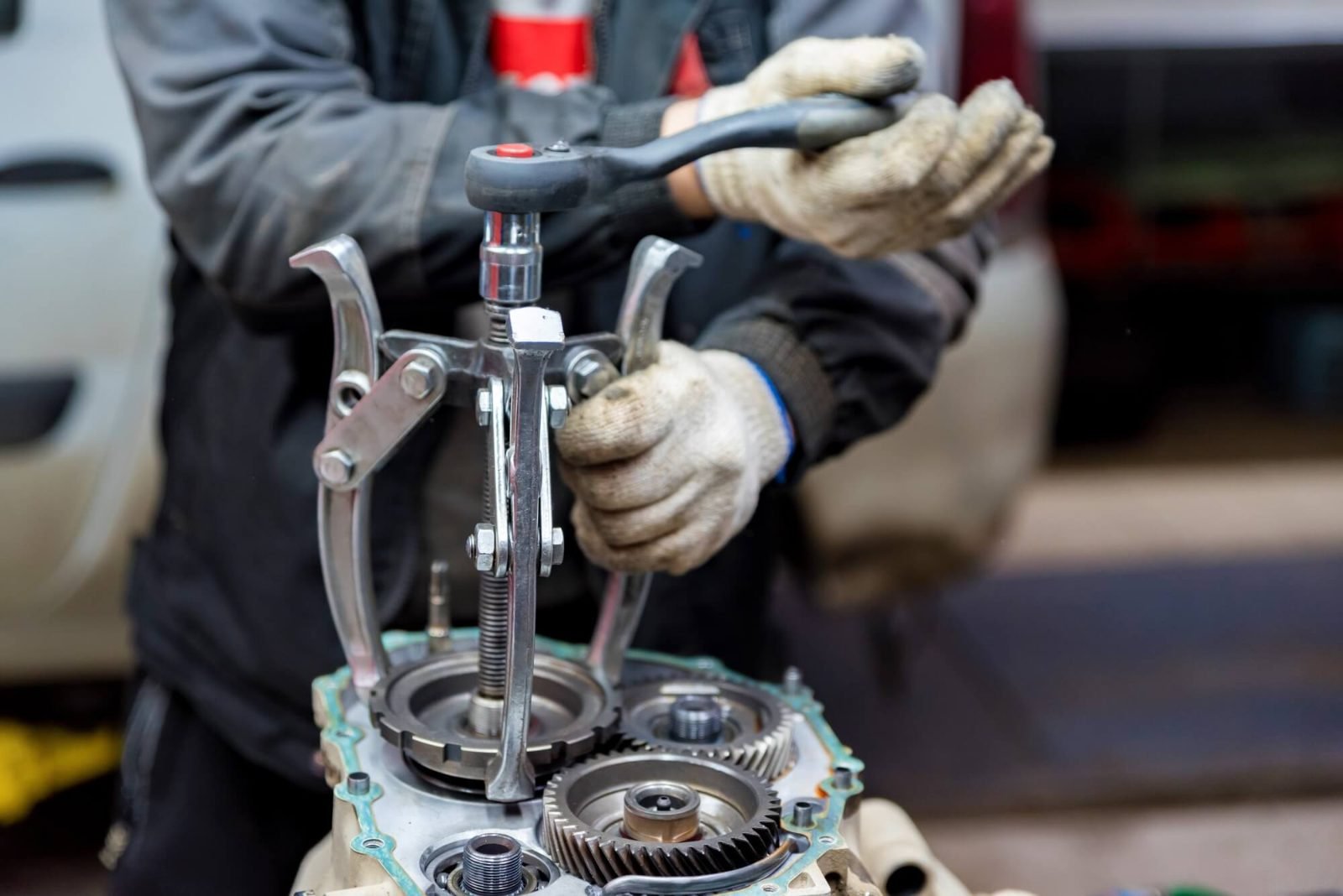
Short answer: A major transmission repair is any job that goes inside the transmission or replaces it: a rebuild, a replacement unit, or internal work on parts like the torque converter, clutch packs, valve body or pump. If your vehicle slips, will not engage a gear, or has metal in the fluid, get it diagnosed before you decide anything. The damage found, the vehicle’s age and the transmission type decide whether repair or replacement makes sense.
Guardian Transmission Repair is a transmission shop serving Marietta, East Cobb, Kennesaw, Acworth, Woodstock, Roswell, Sandy Springs and Sandy Plains. This page explains what major repair means, how the decision usually gets made, and what to ask before you authorize work.
What counts as a major transmission repair?
Major repair means the transmission has to come out of the vehicle or be opened up. Minor work, like a fluid exchange, a pan and filter service, or a leaking seal, can often be done with the transmission in place. Major work covers internal wear and failure.
Typical major jobs include:
- A full rebuild of an automatic, where the unit is removed, taken apart and rebuilt with new parts
- Replacing worn clutch packs, bands or planetary gear sets
- Torque converter replacement after it shudders, overheats or sheds debris
- Valve body and solenoid work that goes beyond a simple solenoid swap
- Replacing the whole transmission with a rebuilt, remanufactured, used or new unit
- Internal repair on a CVT or a manual gearbox, including synchros and bearings
We handle this work across automatic transmission repair, CVT repair and manual transmission repair. For jobs that call for a unit built to fit one specific vehicle, see our custom transmission rebuilds.
What situations lead to a major repair?
Most major repairs start with a symptom the driver can no longer ignore. Others start with a warning light, a tow, or a fluid leak that has been ignored for months.
Here is how common symptoms line up with possible causes. These are possibilities, and only diagnosis confirms which one applies.
Some triggers have nothing to do with symptoms. A used car purchase, a failed inspection of a fleet van, or a tow after a breakdown can start the conversation just as fast. Our guide on how to tell if your transmission is going out ranks the warning signs by urgency, and 5 common automatic transmission problems covers what usually shows up first.
How is the problem diagnosed before a major repair?
Diagnosis should come before any quote for internal work. Depending on the symptoms, it can include a fluid check for level, color and smell, a computer scan for OBD-II trouble codes, a road test, a stall test, a line pressure test and a lift inspection.
Fluid tells a lot. Dark fluid that smells burnt points toward heat and clutch wear. Metallic glitter or a fine gray sludge suggests internal parts are wearing. Low fluid can point to a leak that needs repair before anything else. If low fluid is part of your story, read the 10 symptoms of low transmission fluid.
Codes help but do not finish the job. A transmission control module code can point to a solenoid, a sensor, a wiring fault or a mechanical problem that created the electrical symptom. Testing separates those.
Is the diagnostic fee applied to the repair?
Shops handle this differently. Some charge a diagnostic fee and credit it toward the repair if you proceed. Others do not. Ask before you authorize diagnosis: what the fee is, what testing it covers, and whether it is credited. Get the answer in writing if you can.
Can a transmission be repaired without replacing it?
Yes, when the damage is limited and the housing, gears and other hard parts are still serviceable. A slipping unit with worn clutch packs and a failed solenoid can often be repaired. Replacement becomes the better path when the case is cracked, the gear sets are badly damaged, or parts are hard to source.
The real question is how far the damage has spread. A transmission driven a short time after it started slipping may need clutches and seals. One driven for weeks may have debris through the valve body, the torque converter and the cooler. The cost climbs because more has to be cleaned, checked and replaced.
What happens during a rebuild?
A rebuild follows a standard sequence in the industry. Individual shops vary in the details, so ask any shop how it handles each stage.
- Removal: the transmission is separated from the engine and drivetrain and taken out.
- Teardown: the unit is disassembled so every part can be seen.
- Cleaning: housings, gear sets and passages are cleaned of debris and old friction material.
- Inspection: parts are checked for wear, scoring and cracks. Some get replaced and some are reused.
- Parts replacement: worn items such as clutches, seals, gaskets and often solenoids and filters are replaced.
- Reassembly: the unit is built back to specification and set up.
- Testing: some shops bench-test before installation.
- Reinstall: the unit goes back in, and the cooler, lines and mounts are addressed.
- Post-repair road test: the shop checks shift quality, engagement and fluid level under real driving.
Timeline depends on the extent of damage, parts availability and the shop’s schedule. A rebuild takes longer than swapping in a ready unit. Ask for a realistic completion date once parts are confirmed, not before.
Rebuilt, remanufactured, used or new: which unit fits?
When a transmission is replaced, the unit comes from one of four places. Definitions of “remanufactured” in particular vary by seller, so ask what was done to the unit and what the warranty covers.
Core condition matters. If a replacement unit is quoted with a core charge, ask what condition your old transmission must be in to avoid losing that deposit. Also ask whether the warranty covers parts and labor, how long it lasts, and whether it is honored only locally or nationwide.
Is it worth repairing a transmission on a high-mileage car?
Often yes, if the rest of the vehicle is sound. Compare the repair quote to the vehicle’s value and to what a replacement vehicle would cost you. Mileage alone does not decide it. Condition of the engine, body, suspension and rust decides it.
A few questions help:
- Has the vehicle been maintained, with records?
- Does the engine run well and not burn oil?
- Is the repair covered by a warranty you can use?
- Would a replacement vehicle cost you more per month than the repair?
For a work truck or a van that earns money, downtime counts too. A repair that gets the vehicle working again may beat shopping for a replacement for a week or more.
Is a CVT worth repairing?
Sometimes. A CVT uses a continuously variable system instead of a set of fixed gears. Heat, old or wrong CVT fluid, and worn internal components are common reasons they fail. Some CVTs are repairable, and some are cheaper to replace than to open up, depending on the make and the damage.
A TCM software update can fix some shift complaints, which is worth checking before assuming the unit is finished. If a CVT has already suffered major internal damage, replacement is more likely. See our CVT transmission repair page for specifics. Price depends on make, model, year, parts availability and extent of damage, so a CVT quote needs a vehicle-specific diagnosis.
What drives the cost of a major transmission repair?
No honest number exists without knowing the vehicle and the damage. These factors set the price:
- Make, model and year
- Transmission type: automatic, CVT or manual
- Drivetrain layout: front-wheel, rear-wheel, all-wheel or four-wheel drive
- Extent of damage, including how much debris spread
- Parts availability for the specific unit
- Labor hours and the shop’s hourly rate
- Whether you choose a rebuild, a remanufactured unit, a used unit or a new one
Be wary of a firm price given over the phone with no diagnosis. Ask for a written estimate that separates parts, labor and any core charge.
Will an extended warranty or service contract cover the repair?
It might. Coverage depends on the contract’s terms, and many require authorization before teardown begins. Read your contract, call the administrator, and ask the shop to document the failure so a claim can be reviewed.
A manufacturer warranty and a service contract are different things. Federal law, the Magnuson-Moss Warranty Act, generally means a manufacturer cannot void a warranty only because an independent shop did the service. It does not require coverage of damage the warranty excludes. If you have a warranty claim in progress, ask us how to handle the paperwork before work starts.
What else gets checked during major transmission work?
A transmission does not work alone, so related parts often come up during the job:
- Cooler and cooler lines, which can hold debris after an internal failure
- Engine and transmission mounts, which affect shift feel and vibration
- Wheel speed sensors and the mass airflow sensor, which can send bad data that mimics a transmission problem
- Driveshaft, U-joints, axles and CV joints on rear-wheel, all-wheel and four-wheel drive vehicles
- The transfer case and differential on four-wheel and all-wheel drive vehicles
After a rebuild, fluid service intervals matter. Our transmission fluid service page covers that, and 7 mistakes that kill transmissions explains what shortens a rebuilt unit’s life.
Why bring a major repair to Guardian Transmission Repair?
We are a transmission shop. That is our primary business category, and we work on the systems this page describes: automatic, CVT and manual transmissions, plus fluid service and custom rebuilds. We serve Marietta, East Cobb, Kennesaw, Acworth, Woodstock, Roswell, Sandy Springs and Sandy Plains, for individual drivers and for businesses with vehicles that need to get back to work.
We have not listed certifications on this page. If ATRA membership or ASE technician certification matters to you, ask any shop you consider, including us, to show proof. Our guide on how to choose a transmission shop in Marietta lists what to ask, and it applies to us as well.
Before you authorize major work, get these in writing: the diagnosis, the repair option, the price broken into parts and labor, the warranty terms and the expected completion date. Browse the full list of drivetrain services if the problem may extend past the transmission itself.
Major transmission repair FAQs
What is the most common transmission repair?
Leaks from seals and gaskets, solenoid replacement and fluid service are among the more frequent jobs, and none of them is a major repair on its own. Major work usually follows when a problem is left alone and wear spreads.
Can I keep driving with a slipping transmission?
Driving on it speeds up damage. Slipping creates heat and friction material that circulates through the unit. If it will not move, avoid driving it and ask the shop about towing or drop-off options.
How do I know whether to repair or replace?
The diagnosis answers it. Limited internal wear usually points to repair. A cracked case, heavy gear damage or hard-to-find parts usually points to a replacement unit.
Does a rebuilt transmission come with a warranty?
Warranty terms differ by shop and by unit. Ask about length, whether parts and labor are both covered, and whether coverage is local or nationwide. Get the terms in writing.
Does the work differ for a manual transmission?
Yes. Manual repair centers on the clutch disc, pressure plate, flywheel, throwout bearing, slave and master cylinders, synchros and shift linkage. Our manual transmission repair page covers those jobs.
Still worried about your transmission?
We drive it, scan it, and put it on the lift for free. No salespeople, ever.