
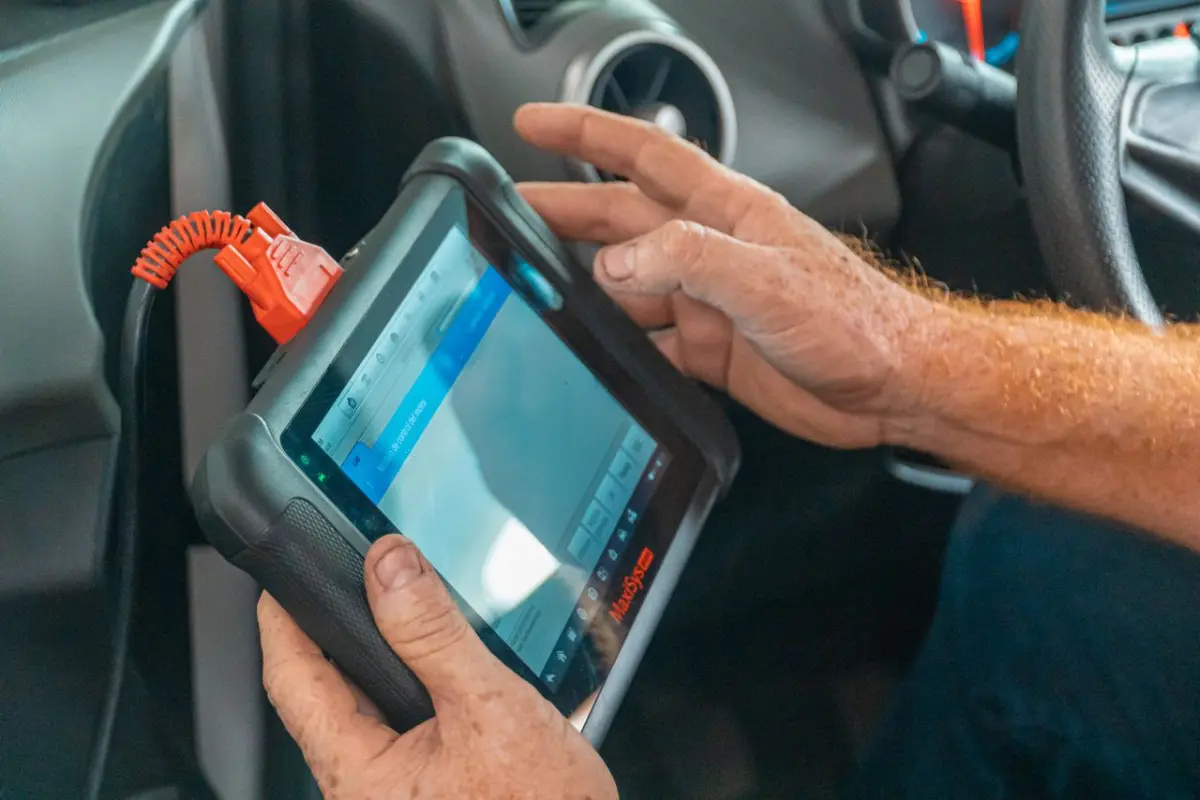
Short answer: A transmission computer diagnostic reads the trouble codes and live data stored by your vehicle’s control modules, then uses that information to decide which physical tests come next. The scan points to the system or circuit that is misbehaving. A clean scan can still hide a mechanical failure. If your vehicle slips, shifts hard, or has a warning light on, a scan is usually the first step in Marietta before anyone talks about a rebuild.
What does a transmission computer diagnostic involve?
A computer diagnostic connects a scan tool to the OBD-II port and reads stored and pending trouble codes, freeze-frame data, and live data from the engine and transmission control modules. Diagnosis then adds fluid checks and hands-on tests to confirm what the data suggests.
Most modern automatics and CVTs are run by a transmission control module, or TCM. On some vehicles it is a separate box. On others it is built into the engine computer. The TCM watches input speed, output speed, throttle position, and fluid temperature. It then commands the solenoids in the valve body to apply clutches and bands at the right moment. When what it commanded and what actually happened do not match, it stores a code.
Some codes are generic across makes. P0730 points to an incorrect gear ratio. P0741 points to a torque converter clutch that is not performing as commanded. P0700 only tells you the TCM has stored its own codes and wants a deeper read. Many manufacturers also use codes of their own, so the number alone is a starting point.
How do I know if my transmission is failing?
The common signs are slipping, delayed engagement, harsh shifts, shuddering, neutralizing, overheating, leaks, grinding, a burning smell, and a warning light. Any of these is a reason to scan the vehicle. Our guide to how to tell if your transmission is going out ranks the signs by urgency.
The table shows why a scan alone is not enough. The same symptom can have an electronic cause or a mechanical one.
If the symptom is a slow-building problem, our article on common automatic transmission problems covers what usually comes first.
What can live data show that a basic code reader cannot?
Live data shows what the transmission is doing while the vehicle runs. A technician can compare commanded values to actual values and spot trouble before a code is ever stored. A basic code reader usually shows only the stored code.
Depending on the vehicle and the scan tool, live data can include:
- Commanded gear compared with the gear ratio the speed sensors report
- Torque converter clutch slip
- Transmission fluid temperature
- Input and output shaft speed
- Solenoid commands and pressure control values
- Throttle position and engine load as the TCM sees them
The data has limits. A code for a solenoid circuit can mean a bad solenoid, a damaged wire, a bad connector, or a valve body problem that is dragging the solenoid down. Replacing the part named in the code without testing is a common way to spend money and keep the problem. The data narrows the list, and testing finishes the job.
What tests can follow the scan?
Depending on the symptoms and what the scan shows, diagnosis can include several physical checks. None of them replaces the scan, and the scan does not replace them.
- Fluid check. Level, color, and smell tell a lot. Dark fluid with a burnt smell suggests heat and friction wear. Metal or clutch material in the fluid points to internal damage. Our page on transmission fluid service explains what fluid maintenance covers, and the article on symptoms of low transmission fluid shows how to check your own.
- Road test. Some faults only appear under load, at temperature, or at a certain speed. A test drive lets the technician feel the shift and compare it with the live data.
- Stall test. This checks converter and clutch holding under load. It is hard on a transmission, so it only makes sense when the other findings support it.
- Line pressure test. A gauge on the transmission’s pressure port shows whether the pump and valve body are making the pressure they should in each range.
- Lift inspection. With the vehicle raised, a technician can look for leaks, damaged cooler lines, bad mounts, and driveline play that can mimic a transmission problem.
A clogged filter can also cause pressure and shifting trouble. We cover that in signs of a clogged transmission filter.
Can a transmission be repaired without replacing it?
Often, yes. When diagnosis traces the problem to a sensor, a solenoid, wiring, low or degraded fluid, a leaking seal, or a restricted cooler line, the repair can be much smaller than a rebuild. When internal parts are worn, a larger repair is on the table.
That is the real value of diagnosis. It sorts problems into three groups: those that need a service, those that need a targeted repair, and those that need the transmission opened up. For targeted work, see our automatic transmission repair page. If teardown shows damage to clutch packs, bands, the pump, or the planetary gear sets, a rebuild may be the better answer, and the custom transmission rebuilds page explains that route.
Rebuild versus replacement depends on the extent of the damage, the make and model, parts availability, and the warranty on each option. Diagnosis supplies the facts for that decision.
Do CVT and manual transmissions get scanned too?
CVTs depend heavily on scan data. Most traditional manual transmissions have no transmission computer, so the scan tells you less and the physical inspection matters more.
A CVT uses a belt or chain running between pulleys, controlled by the TCM and hydraulic pressure. Heat, fluid condition, and TCM software all affect how it behaves. Live data on temperature, pulley ratio, and commanded versus actual values is often central to diagnosis. Our CVT transmission repair page covers that work.
A manual has a clutch disc, pressure plate, flywheel, throwout bearing, and often a hydraulic master and slave cylinder. Slipping, a high clutch pedal, or hard shifting can sometimes be related to those parts or to the synchros and shift linkage, but an inspection is needed to find the actual cause. A scan may still be useful if a warning light is on, since engine and speed sensors feed other systems. The physical checks are on the manual transmission repair page.
How much does a transmission diagnostic cost?
The cost depends on the shop, the vehicle, and how deep the diagnosis goes. A quick code read costs less than a full diagnosis with a road test, pressure test, and lift inspection. Ask up front whether the fee is credited toward the repair.
Before you hand over keys, ask any shop, including us, these questions:
- What does the diagnostic fee include?
- Is the fee credited if I approve the repair?
- Will I get the findings in writing before work starts?
- Which parts of the diagnosis might need more time or teardown?
We are not publishing a price here because the right number depends on the vehicle and the symptoms. Call us with the make, model, year, and what the vehicle is doing, and we can tell you what applies.
How long does a transmission diagnosis take?
A scan itself is short. A full diagnosis takes longer because it can include a road test, fluid inspection, pressure testing, and a lift inspection. Intermittent problems can take extra time because the fault has to show itself.
If the findings point to a repair, parts availability and the type of repair set the next timeline. A sensor replacement and a full rebuild are very different jobs, and the schedule for each depends on the vehicle. Ask for an estimate in writing that covers both parts and labor.
What should I do before I bring my vehicle in?
A few steps make the diagnosis faster and the results more reliable.
- Write down when the problem happens: cold start, after highway driving, in a certain gear, or when towing.
- Do not clear the codes. Stored codes and freeze-frame data help the technician.
- Check the fluid level if your vehicle has a dipstick, and note the color and smell.
- Bring maintenance records, including any recent fluid service.
- Stop driving if the vehicle slips badly, will not move, or overheats. Driving a failing transmission can turn a small repair into a large one. Our list of mistakes that kill transmissions covers the usual ones.
If the vehicle cannot be driven safely, ask about drop-off and towing options when you call.
Why bring a diagnostic question to a transmission shop?
A general scan at a parts counter reads codes. A transmission shop is set up around what comes after the code: how the fluid, valve body, clutches, converter, and control module work together. Guardian Transmission Repair is a transmission shop in Marietta, GA, and that is the work we are built around.
We serve both homeowners and businesses. A daily commuter and a work truck or delivery van share the same basic problem, a vehicle that needs to be running. We also serve drivers in Acworth, Kennesaw, East Cobb, Woodstock, Roswell, Sandy Springs, and Sandy Plains.
If you are comparing options, our guide to choosing a transmission shop in Marietta lists what to ask any shop, including us. For the full range of work, see our services overview.
Computer diagnostics FAQ
Will my check engine light always come on for a transmission problem?
No. Electrical and sensor faults usually set a code and a light. Mechanical wear, such as worn clutches or low pressure, may not set any code until the TCM detects a mismatch. A vehicle can slip or shudder with no light on, so symptoms matter as much as codes.
Is a free code read at a parts store the same as a diagnosis?
A code read tells you what is stored. Diagnosis explains why. A code can point to a circuit, a sensor, or a part, but testing is what confirms the cause. Replacing parts from a code alone can leave the real fault in place.
Can a bad sensor cause shifting problems?
Yes. The TCM relies on signals such as vehicle speed, wheel speed, and engine load, and the MAF sensor feeds engine load data. A faulty input can cause harsh shifts, wrong shift points, or limp mode. Diagnosis checks those inputs before blaming the transmission.
Can I clear the codes and keep driving?
Clearing codes erases information the technician needs, and the codes often return. If the transmission is slipping, overheating, or stuck in one gear, continued driving can add damage. Leave the codes stored and get the vehicle checked.
Do diagnostics apply to imported and domestic vehicles?
Yes, scanning applies to both, though the codes, data, and tools differ by make. Call with your vehicle’s make, model, and year so we can tell you what to expect.
Still worried about your transmission?
We drive it, scan it, and put it on the lift for free. No salespeople, ever.