
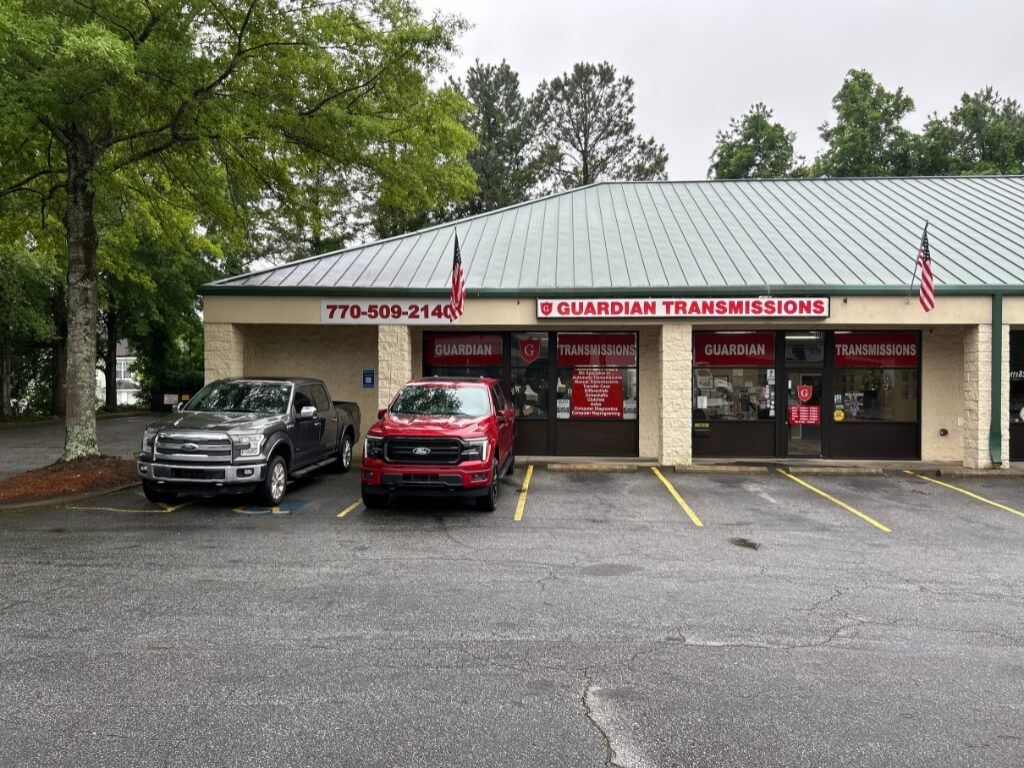
Short answer: A transmission shop diagnoses and repairs the parts that move engine power to the wheels: the transmission, the clutch, the driveshaft, axles, CV joints, differentials, and the transfer case on 4WD and AWD vehicles. If your vehicle slips, hesitates, shifts hard, leaks fluid, or smells burnt, get it looked at before the damage spreads. Guardian Transmission Repair in Marietta, GA handles this work for daily drivers and for the work trucks and vans that businesses depend on.
What does a transmission shop do, and who needs one?
A transmission shop tests, repairs, rebuilds, and replaces transmissions and the drivetrain parts around them. You need one when a vehicle slips out of gear, delays engagement, shifts harshly, leaks fluid, makes grinding or whining noises, or sets transmission trouble codes.
Most of our readers fall into two groups. Homeowners and commuters usually arrive with a vehicle that still runs but feels wrong: a flare between shifts, a lag when moving the shifter from park to drive. Business owners arrive with a different problem. A delivery van, service truck, or shuttle that sits is losing money every day, so the questions become how long the repair takes and whether the vehicle can be returned to work with confidence.
The work splits into a few families: automatic transmissions, CVTs, manual transmissions and clutches, driveline parts, differentials, transfer cases, and the diagnostics that tie them together. Each has its own section below, and each section points to a page that goes deeper. For the basic overview of the core service, start with our Transmission Repair page.
How do I know if my transmission is failing?
The usual signs are slipping gears, revving without accelerating, delayed engagement, harsh or erratic shifts, shuddering, a burnt smell, fluid on the ground, and a warning light. Any one of them justifies an inspection. If several appear together, contact the shop promptly and describe the symptoms. If the vehicle cannot be operated safely, seek appropriate assistance rather than continuing to drive it.
Here is what each one tends to point to:
- Slipping or revving without speeding up: worn clutch packs or bands, low fluid, or a failing torque converter.
- Delay when shifting into drive or reverse: low or degraded fluid, worn internal seals, or low line pressure.
- Harsh shifts: a sticking valve body, a bad solenoid, or a software and sensor problem.
- Shudder at steady speed: often a torque converter clutch issue, though engine misfires can feel similar.
- Fluid spots under the vehicle: seals, gaskets, the pan, or cooler lines. Our Leaking Fluid page covers how to read what you see.
- Dashboard warning or limp mode: the transmission control module has stored a fault. See the Trouble Codes page for how those codes are used.
Fluid is the easiest first check. Level, color, and smell tell you a lot, and our Fluid Level page explains the basics. Procedures differ by vehicle, and some transmissions have no dipstick at all, so your Owner’s Manual is the right reference before you pull anything.
What types of transmission and drivetrain work does a shop cover?
The work covers six areas: automatic transmissions, CVTs, manual transmissions and clutches, driveline parts, differentials, and transfer cases. Diagnostics sit underneath all of them. Each area below has a deeper page.
Automatic transmission repair
An automatic contains a torque converter, planetary gear sets, clutch packs, bands, a valve body with solenoids, a pump, a filter, and seals and gaskets. Problems range from a leaking seal to internal wear that needs a full overhaul. Read Automatic Transmission Repair for the service overview, Automatic Transmissions Repair for how problems vary by design, and Overhaul Automatic Trans for what a full teardown involves.
CVT transmission repair
A continuously variable transmission uses a belt or chain running between pulleys instead of fixed gears. It depends on CVT-specific fluid, it is sensitive to heat, and it often needs control module attention along with mechanical work. Fluid type matters here more than many owners expect. Details are on the CVT Transmission Repair page.
Manual transmission and clutch repair
A manual gearbox relies on a clutch disc, pressure plate, flywheel, throwout bearing, a hydraulic master and slave cylinder on many vehicles, synchronizers, and shift linkage. A slipping clutch, a pedal that feels wrong, or grinding into gear can each be linked to different parts, and an inspection is needed to tell which is involved. Our Manual Transmission Repair page covers the gearbox, and Manual Trans covers owner-level questions. For the clutch itself, see Clutch Repair, Clutch Repair And Service, and Clutch Repairs.
Driveline services: driveshafts, axles, and CV joints
The driveline carries power from the transmission to the wheels. Rear-wheel and 4WD vehicles use a driveshaft with U-joints and sometimes a center support bearing. Front-wheel and all-wheel vehicles use half-shafts with CV joints and boots. A clicking noise in turns or a vibration under load often starts here. Start with Drive Line Services, then go to Driveshaft Repair, Axle Drive Shaft, and Axle Drive Shaft Repair. For joint-specific problems, see Cv Joint Repair, C V Joints, and Constant Velocity Joints.
Differential repair
The differential splits power between the wheels and lets them turn at different speeds. Inside are a ring and pinion, a carrier, and bearings, all lubricated by gear oil, and limited-slip units can need a specific additive. A howl that changes with speed or a whine on deceleration is a common warning. See Differential Repair, Rear Axle Differential, and Rear Differential Repair. Fluid questions are answered on Differential Fluid and Gear Oil.
Transfer case repair
On 4WD and some AWD vehicles, the transfer case sends power to both axles. It uses a chain or gear drive, a shift motor on many models, fluid, and seals. Failure shows up as binding, noise, leaks, or a 4WD mode that will not engage. The Transfer Case Repair page goes into it.
Related work found during transmission jobs
Transmission problems and nearby parts overlap. Engine and transmission mounts, wheel speed sensors, and a Maf Sensor can each cause symptoms that feel like transmission trouble. When the transmission is out of the vehicle or the engine bay is open, items like Timing Belts and Water Pumps may be worth discussing, depending on the vehicle and its service history.
How is a transmission problem diagnosed?
Diagnosis typically combines a fluid check, a computer scan for stored codes, a road test, and a lift inspection. Depending on the symptoms, a stall test or line pressure test may follow. The goal is to find the cause before anyone recommends a repair.
A sound diagnosis works in layers:
- Fluid: level, color, smell, and any metal or friction material in the pan.
- Computer scan: the transmission control module and OBD-II trouble codes show which circuit or sensor flagged a fault. Computer Diagnostics and Computer Scan explain what a scan can and cannot tell you.
- Road test: reproduces the shift quality, slip, or shudder under real load.
- Lift inspection: leaks, mounts, cooler lines, driveline parts, and the exterior of the case. See Lift Inspection and Point Inspection.
- Pressure and stall tests: used when the symptoms suggest internal wear, to separate a pump or clutch issue from a converter issue.
A code is a starting point. A solenoid code can come from the solenoid, the wiring, the valve body, or low fluid pressure. That is why a Thorough Diagnosis matters before parts are ordered, and why having the Vehicle Checked early costs less than waiting. Ask any shop whether the diagnostic fee is credited toward the repair.
Can a transmission be repaired without replacing it?
Often yes. Leaks, worn seals, bad solenoids, a stuck valve body, low or contaminated fluid, a failing sensor, and a worn clutch can all be fixed without swapping the whole unit. Internal damage to hard parts is what pushes a job toward rebuild or replacement.
Cheaper causes get checked first. A shift complaint can end up being a fluid service, a software update, a bad speed sensor, or a failing mount. A transmission that sheds metal, has burned clutch material throughout, or has a damaged case is a different story. The Repairs Or Replacement page lays out where that line usually falls.
Is it better to rebuild or replace a transmission?
It depends on the damage, the vehicle, parts availability, and warranty terms. A rebuild fixes the unit you already have. Replacement swaps in a rebuilt, remanufactured, used, or new OEM unit. Neither is better in every case.
A rebuild generally runs through removal, teardown, cleaning, inspection, parts replacement, reassembly, testing, reinstall, and a post-repair road test. Replacement may involve a core charge, and the condition of your old unit can affect it. Whichever route you choose, get warranty terms in writing: length, whether parts and labor are both covered, and whether coverage is local or nationwide. Our Warranty Services and Warranty Service pages cover what to ask. For the bigger picture on large jobs, see Major Repair and Repair And Replacement.
How much does a transmission repair cost, and how long does it take?
Cost depends on the make, model, year, transmission type, parts availability, labor hours, shop rate, and how much is damaged. Time runs from a same-visit fix for minor issues to several days for a rebuild, depending on parts. A written estimate after diagnosis is the only reliable number.
A fluid leak and a full overhaul are very different jobs, and so are a common domestic automatic and a CVT from an import with limited parts supply. We do not quote prices without seeing the vehicle. Our guide, Transmission Repair Cost in Marietta, GA: What Affects the Price, walks through each cost driver so you can read an estimate with confidence. Timeline is mostly about parts. If a rebuild kit or a replacement unit is not on the shelf, the vehicle waits.
Is it worth repairing a transmission on a high-mileage car?
It can be, if the rest of the vehicle is sound. Compare the repair cost against the vehicle’s value and its other needs, such as rust, engine condition, and suspension wear. A solid body and a healthy engine usually justify a transmission repair.
Mileage alone is a weak reason to give up. Maintenance history matters more. A vehicle with regular fluid service and a failed solenoid is a better candidate than a lower-mileage one that has been towing overheated for years. For a business, add the cost of replacing the vehicle and the downtime that comes with it. Ask your shop to explain what the repair fixes, what it does not, and what else is likely to need attention soon.
What could slipping, hesitation, and burnt fluid mean?
Three symptoms bring in most calls. Each has several possible causes, and none can be confirmed without an inspection or diagnosis.
Why does my car slip or rev without accelerating?
Engine speed rises but the vehicle does not keep up, which can mean the transmission is not holding torque. Possible causes include low fluid, worn clutch packs or bands, a failing torque converter, or a pressure problem. On a manual, a worn clutch disc is one possibility. Only an inspection can show which it is.
Why does it hesitate when I shift from park to drive?
A second or two of delay can point to low or degraded fluid, worn seals that lose pressure while the car sits, or a pump that is losing output, though a diagnosis is needed to know for sure. It tends to get worse over time, so do not ignore it.
What does burnt-smelling transmission fluid mean?
It can mean the fluid has been overheated or the friction material inside is wearing. Dark fluid with a burnt odor calls for an inspection, and possibly a cooler and cooler line check. Heat is the biggest enemy of any transmission, and CVTs are especially sensitive to it.
How do I choose a transmission shop?
Choose on four things: a clear diagnostic process, written estimates that separate parts and labor, defined warranty terms, and experience with your type of vehicle. Ask what the diagnostic fee covers and whether it is credited toward the repair.
A few questions worth asking any shop:
- Will you explain the cause before recommending the repair?
- Do you work on my make, including imported cars? See Imported Cars.
- Who does the work, and what training do they have? Our Automotive Technician page covers what to look for.
- What does the warranty cover, for how long, and where?
- Are towing or drop-off options available if the vehicle cannot be driven?
If you drive under a service contract or an extended warranty, ask whether the shop accepts it. Under the Magnuson-Moss Warranty Act, an independent shop can service a vehicle without automatically voiding a manufacturer warranty, though you should keep records of the work. For fleets, ask about scheduling and how updates are communicated, since downtime is the real cost. Our Automotive Service page shows the wider range of work Guardian handles.
Which areas does Guardian Transmission Repair serve?
Guardian Transmission Repair serves Marietta, East Cobb, Kennesaw, Acworth, Woodstock, Roswell, Sandy Springs, and Sandy Plains, GA. If you are north of the city, see Transmission Repair Roswell for service details in that direction.
Transmission shop FAQs
What is the most common transmission repair?
Fluid-related and leak repairs are among the most frequent: seal and gasket replacement, fluid service, and solenoid or sensor replacement. On manual vehicles, clutch replacement is the most common. Full rebuilds happen when the problem has been left to progress.
Should I keep driving with a slipping transmission?
It is best to have it checked promptly. Slipping can create heat and friction debris, which may turn a smaller repair into a larger one. Contact the shop, describe the symptoms, and ask how to proceed. If the vehicle cannot be operated safely, seek appropriate assistance rather than continuing to drive it.
Does a transmission shop work on more than the transmission?
Yes. Drivetrain work includes clutches, driveshafts, CV joints, axles, differentials, and transfer cases, along with the diagnostics and related items that come up on the same vehicle.
Can regular fluid service prevent transmission failure?
It helps. Fresh fluid of the correct type protects clutches, seals, and valve body parts, and it carries heat away. Your owner’s manual lists the correct fluid and the service interval for your transmission.
Do you work on commercial vehicles?
Guardian Transmission Repair serves both residential and commercial customers. Call with the vehicle’s year, make, model, and symptoms so we can discuss how to get it diagnosed.
—
Still worried about your transmission?
We drive it, scan it, and put it on the lift for free. No salespeople, ever.