
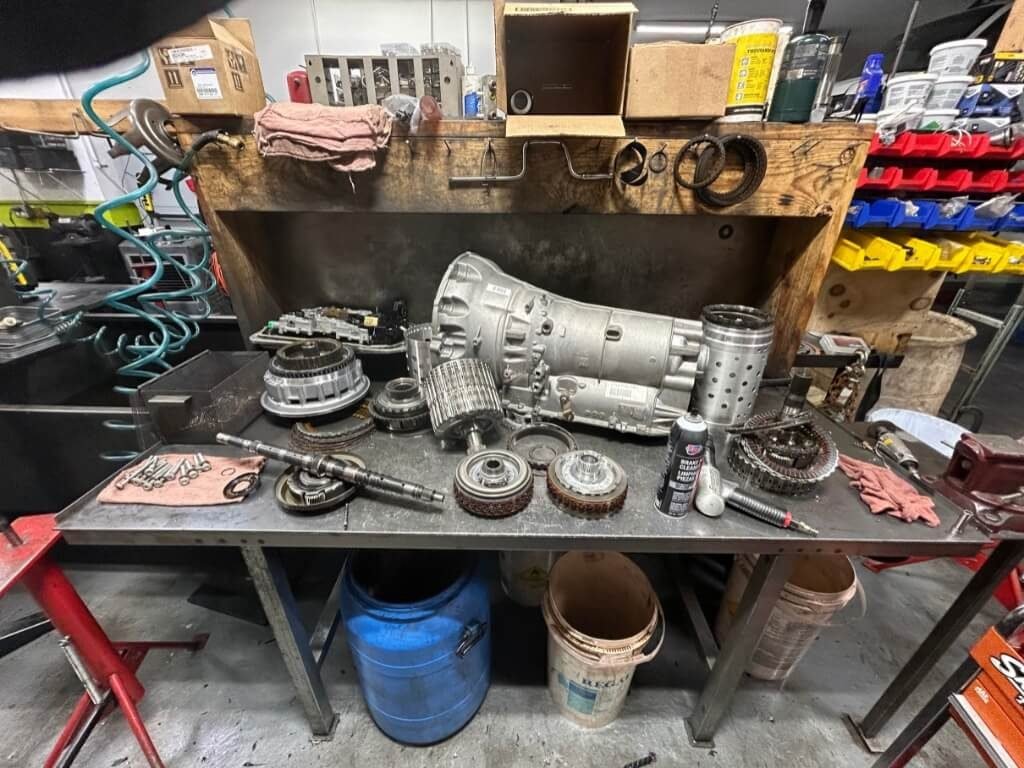
Short answer: If your manual car grinds going into gear, jumps out of gear, or revs without gaining speed, the fault is in one of two places: the clutch system or the gearbox. Clutch faults are more common and the repair is smaller. Gearbox faults, like worn synchronizers or bearings, mean pulling the transmission and opening it up. The symptom usually points to which one you have.
Guardian Transmission Repair is a transmission shop in Marietta, GA. Our service area includes Marietta, East Cobb, Kennesaw, Acworth, Woodstock, Roswell, Sandy Springs and Sandy Plains. The vehicle might be a weekend sports car or a work truck that has to be back on the job. This page explains what manual transmission repair involves so you can judge a diagnosis and a quote.
What does manual transmission repair involve?
Manual transmission repair covers the clutch, the clutch controls, and the gearbox itself. Depending on the fault, it can mean bleeding a hydraulic clutch, replacing a clutch kit, or removing the transmission to replace worn gears, bearings, and synchronizers inside the case.
A manual has no torque converter, valve body, or solenoids. The engine connects to the gearbox through a clutch disc squeezed against the flywheel by a pressure plate. You move that connection with a pedal, and you pick gears with a shift linkage or cable. Every one of those parts wears in its own way, so the first job is working out which part has failed.
How do I know if my manual transmission or clutch is failing?
Watch for grinding when shifting, popping out of gear, a clutch that slips under load, a pedal that feels soft, stiff, or sticks to the floor, whining noises, or fluid on the ground under the bellhousing area. Each symptom points to a short list of causes.
If you are also unsure whether a problem is serious, our guide to eight warning signs that a transmission is going out, ranked by urgency is a useful companion.
Is it the clutch or the gearbox?
Clutch problems show up in how the pedal feels and in slipping. Gearbox problems show up in how the shifter feels and in noises that depend on gear. A road test, a pedal and linkage check, and a fluid and leak inspection are the usual starting points for telling them apart.
Two quick examples. A car that slips in fifth gear on a hill but shifts cleanly through the gears points at the clutch. A car that grinds only into second, with a clutch that engages normally, points at that gear’s synchronizer. Mixed symptoms happen too, and a worn gearbox can also be carrying a clutch that is near the end of its life. That is why the diagnosis comes before the quote.
What gets repaired inside a manual gearbox?
Inside the case, the usual wear items are synchronizers, gear teeth, bearings, the input shaft, shift forks, and seals. Which ones need replacing depends on how far the wear has gone, which you only learn once the unit is apart and cleaned.
Synchronizers
A synchronizer matches the speed of a gear to the speed of the shaft before the gear locks in. When the friction surface wears down, you hear and feel a grind as you shift. Gears used most often tend to wear first. Rough, fast shifting and the wrong gear oil speed this up.
Gears and engagement teeth
Gear teeth can chip or wear. The small teeth that lock a gear to the shaft can round off, which is a common reason for a car that pops out of gear. Damage like this may call for replacing the gear, and sometimes its mate, depending on how bad it is.
Bearings and the input shaft
Bearings carry the shafts. When they wear, you get whine, rumble, and play in the shafts that makes gears mesh badly. A worn input shaft bearing or pilot area can also cause noise and drag at the clutch end.
Gear oil
The fluid in a manual gearbox varies by vehicle. Some call for gear oil, others for ATF or a specialty fluid, so the factory specification matters. Old or incorrect fluid shortens synchronizer life. Our page on transmission fluid service in Marietta and East Cobb and our explainer on transmission fluid types and when to change them cover fluid in more detail.
What does a clutch replacement include?
A clutch replacement normally means the disc, pressure plate, and release bearing, with the flywheel inspected and either resurfaced or replaced. Many cars also get a new pilot bearing or bushing where fitted, plus a check of the master and slave cylinders.
The transmission has to come out to reach any of it, so there is a labor overlap worth using. If you are paying to remove the gearbox, the rear main seal and input shaft seal are cheap to renew while access is open, and a leaking seal that contaminates a new clutch is an expensive lesson.
Flywheel: resurface, replace, or convert
A single-mass flywheel can often be resurfaced if the friction surface is in good shape. A dual-mass flywheel is built with springs and dampers to absorb vibration, and it generally cannot be resurfaced. A worn one rattles at idle. Replacing it costs more, which leads some owners to ask about a solid flywheel conversion. For some vehicles that kit exists. The tradeoff is more vibration and noise, so it suits some driving habits better than others.
Hydraulic clutch parts
Most modern manuals use a hydraulic system with a master cylinder at the pedal and a slave cylinder at the gearbox. If either leaks, the clutch will not fully release. Because they sit right where the clutch work happens, they are often looked at during a clutch job.
Is it better to rebuild or replace a manual transmission?
Rebuilding repairs your own gearbox with new hard and soft parts as needed. Replacing swaps in a used, remanufactured, or new unit. Rebuilding keeps your original casing and gear ratios. Replacing can be faster when parts for your model are hard to source.
The choices break down like this:
- Repair: a clutch job, hydraulic repair, seal, or linkage fix. This suits problems that stop outside the gearbox case.
- Rebuild: the gearbox is disassembled, cleaned, inspected, and worn parts are replaced before reassembly.
- Remanufactured: a unit rebuilt elsewhere to a set standard. A core charge may apply when you send back the old one.
- Used: the lowest upfront cost, with the least known history.
If your gearbox is unusual, modified, or has a part history that makes off-the-shelf options awkward, take a look at our custom transmission rebuilds in Marietta.
How much does manual transmission repair cost?
Cost depends on which parts fail, the vehicle, and the labor hours to reach them. A hydraulic bleed or slave cylinder is a small job. A clutch kit is bigger. A gearbox rebuild is bigger again. We do not quote numbers without looking at the car.
The main cost drivers:
- Make and model. Import and domestic gearboxes differ in parts cost and in how hard they are to remove.
- Drivetrain layout. Front-wheel drive, rear-wheel drive, and all-wheel drive cars have different amounts of stuff to move out of the way.
- Flywheel type. A dual-mass flywheel adds meaningful parts cost.
- Extent of hard-part damage. Gears, shafts, and the case cost more than synchronizers and bearings.
- Repair path. Repair, rebuild, and replace each carry different labor and parts totals.
Ask for the quote to name what is included and what condition would change it.
How long does manual transmission repair take?
A hydraulic fix can be quick. A clutch replacement means removing the transmission, and a gearbox rebuild takes longer because the unit is taken apart, cleaned, inspected, and reassembled. Parts availability for your model can add days.
If the car is a work vehicle, mention that when you call, since the cost of downtime may affect which repair option makes sense for you.
Is it worth fixing a manual transmission on an older car?
Often yes, when the rest of the car is sound. A clutch or gearbox repair costs less than a replacement vehicle, and manuals have fewer parts to fail than automatics. It stops making sense when the repair cost nears what the car is worth and other big problems are waiting.
A few ways to decide:
- Compare the quote to what you would pay for a comparable car as well as to the car’s book value.
- Check the body, engine, and suspension. A fresh clutch in a car with a rusted frame is a poor bet.
- Consider how long you plan to keep it. A long-term keeper justifies a rebuild more easily.
What should I ask a shop before approving the repair?
Get the diagnosis in plain words, then ask what the quote covers. These questions work at any shop, including ours:
- What failed, and how do you know?
- Which parts are being replaced, and are they new, remanufactured, or used?
- Will the flywheel be resurfaced or replaced, and why?
- Are seals, the release bearing, and the pilot bearing included?
- What could change the price once the gearbox is open?
- What warranty comes with the work, covering parts and labor, and for how long or how many miles?
- If I decide to do nothing, what happens next?
A written estimate that lists these items makes comparing shops easier.
Why bring a manual to Guardian Transmission Repair?
Transmission work is the whole business here. Guardian Transmission Repair is a transmission shop, so manual gearboxes, clutches, and drivetrain faults are the kind of problem we are set up to look at. We serve Marietta and the surrounding communities, including East Cobb, Kennesaw, Acworth, Woodstock, Roswell, Sandy Springs and Sandy Plains.
When you call, describe the symptom as precisely as you can: which gear, when it happens, what the pedal feels like, any leaks or smells. That detail narrows the diagnosis before the car arrives. Our full range of drivetrain services covers the line from the engine back to the wheels, which matters when a manual problem turns out to involve more than the gearbox.
What related drivetrain work might come up?
Sometimes the manual transmission is only part of the story. A clutch job can reveal a leaking engine seal. A noisy driveline can be a bad axle or driveshaft joint rather than the gearbox. If you drive more than one vehicle, the other one may need different work:
- An automatic with slipping or harsh shifts belongs on our page for automatic transmission repair in Marietta and East Cobb.
- A vehicle with a continuously variable transmission has its own page for CVT transmission repair in Marietta and East Cobb.
- If you are unsure which type you have, the four transmission types and what repair looks like for each explains the differences.
Manual transmission repair FAQs
Can I keep driving with a slipping clutch?
For a short time, usually, but it gets worse and can damage the flywheel and pressure plate as the disc wears down. A clutch that fails completely can leave you stranded. If it slips now, book the diagnosis before it quits.
Does the flywheel have to be replaced with the clutch?
Not always. A single-mass flywheel in good condition can often be resurfaced. A dual-mass flywheel generally cannot be resurfaced, and if it is worn or rattles at idle, it is usually replaced with the clutch.
Why does my manual grind into only one gear?
One gear grinding while the others shift fine can point to that gear’s synchronizer, but it is only a possibility until the car is inspected. Low or wrong gear oil can also contribute, so fluid is worth checking first. If the grind continues, the gearbox may need to be opened up to confirm the cause.
Why does my manual pop out of gear?
Common causes include worn engagement teeth on the gear, worn shift mechanism parts inside the gearbox, worn bearings that let the shafts move, or linkage problems. A diagnosis separates a simple linkage fix from internal wear.
What fluid does a manual transmission use?
It depends on the vehicle. Some use gear oil, such as hypoid gear oil, and others call for ATF or a specialty fluid. It is best to follow the manufacturer’s specification, since the wrong fluid can hurt shifting and wear parts faster.
Is a hard clutch pedal always a clutch problem?
No. A hard pedal can come from the pressure plate, a hydraulic fault, a binding cable, or a pedal assembly issue. A pedal that sinks or feels soft more often points to a hydraulic leak in the master or slave cylinder.
Still worried about your transmission?
We drive it, scan it, and put it on the lift for free. No salespeople, ever.